What float value actually is
When a skin is generated — unboxed from a case, won from a trade-up, or dropped at the end of a match — the game rolls a random float value (officially the "paint wear"). It's a decimal between 0.00 and 1.00. The lower the number, the less wear the texture shows; the higher the number, the more scratches, scuffs and fading appear on the model.
Crucially, the float is baked in permanently. It does not change when you equip the skin, store it, or trade it. A skin you own at 0.21 will be 0.21 forever. The only way to hold a lower-float copy is to buy a different one — which is why float is one of the main drivers of price differences between two listings of the "same" skin.
The five wear tiers and their float ranges
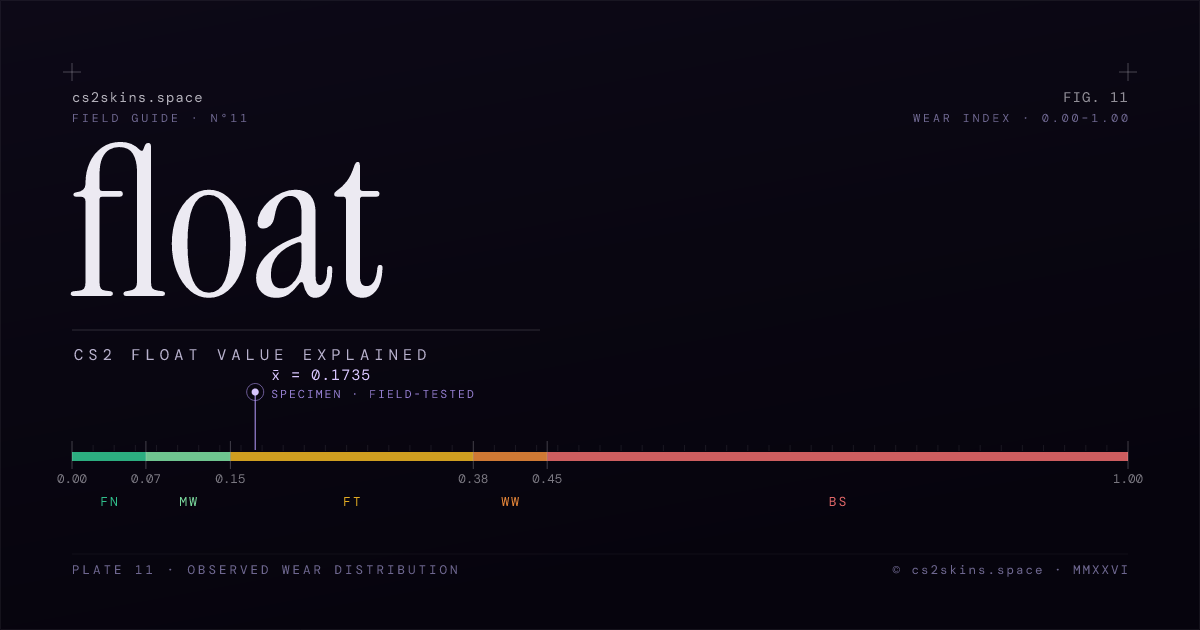
Valve buckets the continuous 0–1 float into five named wear tiers (exteriors). These are the labels you see on every listing:
- Factory New (FN) — float 0.00 to 0.07. Pristine, no visible wear. Commands the highest prices.
- Minimal Wear (MW) — float 0.07 to 0.15. Tiny imperfections, still very clean in-game. The value sweet spot for many skins.
- Field-Tested (FT) — float 0.15 to 0.38. Noticeable wear, but the most-traded and most affordable tier. The default pick for players.
- Well-Worn (WW) — float 0.38 to 0.45. Heavily faded. A narrow band that's often surprisingly cheap.
- Battle-Scarred (BS) — float 0.45 to 1.00. The most worn tier, and usually the cheapest — though some art styles (Asiimov, Hyper Beast) still look great here.
Notice the band widths differ. Field-Tested spans a huge 0.23 of the scale, so two Field-Tested copies can look quite different — a 0.16 FT is nearly Minimal Wear, while a 0.37 FT is almost Well-Worn. Battle-Scarred covers more than half the entire range. This is why the wear label alone never tells the full story.
Why two "Factory New" skins can cost very different amounts
Within a single wear tier, float still matters. A Factory New skin at 0.001 is visually flawless and sits at the bottom of the float range, so collectors pay extra for it. A 0.069 Factory New — technically the same tier — is one hair away from Minimal Wear and trades for less.
The premium is steepest at the extremes. The lowest achievable floats ("black scratches" or sub-0.000x copies on some finishes) and the highest possible floats both attract collectors who want a record-grade example. For ordinary players, though, the difference between a 0.02 and a 0.06 Factory New is invisible in a match — paying double for the lower float is a collector's call, not a practical one.
Float caps — why some skins never reach Factory New
Every skin has a minimum and maximum float cap set by its creator. These caps clip the 0–1 range. The famous example is the AK-47 | Redline: its float is capped at a minimum of roughly 0.10, so it can never be Factory New — the cleanest Redline you can buy is Minimal Wear. Other skins start at 0.00 but cap their maximum below 1.00, so they never appear in Battle-Scarred.
This is why you'll see some finishes that simply don't exist in certain wear tiers. Before hunting for a Factory New copy of a skin, check whether that skin can even roll one — the wear range is listed on every skin page in our catalog.
When a low float is worth paying for — and when it isn't
Float matters most on skins with large, clean painted surfaces where wear is obvious: gradient finishes, solid colours, and detailed art like the AK-47 | Vulcan or knife finishes such as Doppler and Marble Fade. On these, a low float keeps the artwork crisp and is genuinely worth a premium.
Float matters least on skins that are designed to look worn — Asiimov, Bloodsport, Hyper Beast and most "grunge" styles wear gracefully, so a mid-float Field-Tested looks almost identical to a Factory New at a fraction of the price. For these, paying up for a low float is wasted money.
A practical rule: decide on the wear tier first based on how the art holds up, then buy the lowest float you can comfortably afford within that tier. Don't overpay to cross into a higher tier unless you're collecting.
Float and trade-up contracts
Float also governs trade-up contracts. The output skin's float is calculated from the average float of your ten input skins, scaled into the output's own float range. That means feeding a trade-up with low-float inputs produces a lower-float — and therefore more valuable — output. Float-farming inputs is a core part of advanced trade-up strategy. (We'll cover the full maths in a dedicated trade-up guide.)
How to read float before you buy
Every tradeable skin exposes an in-game inspect link, and reputable marketplaces show the exact float in the listing's spec panel — not just the wear label. Third-party inspector tools display float and pattern index directly. Treat any listing that hides the precise float with caution, especially near a tier boundary where a fractional difference changes the price bracket.
On our skins catalog every weapon page lists the wear range and float caps for the finish alongside a live price grid across dozens of marketplaces, so you can sanity-check whether a listing's float justifies its asking price. Start with the AWP hub or the AK-47 hub, or browse value picks in our budget AWPs list.
Float, in one sentence
Float is the permanent 0–1 wear number that sets a skin's exterior tier and nudges its price within that tier — pick the wear that suits the art, buy the lowest float you can justify, and always confirm the exact number before you pay. For the full vocabulary, see our CS2 skins glossary.