What Crimson Web actually is
Crimson Web is one of the original Counter-Strike finishes: a rich, saturated red base with black, cracked spider-web patterns layered over the metal. It appears on several knives as well as a couple of weapons, and it has stayed a collector favourite for years thanks to that striking red-on-black look. As a deep red finish, it photographs and inspects beautifully — but two copies of the exact same knife can look completely different and trade at completely different prices.
The reason is that Crimson Web isn't a uniform paint job. The web texture is scattered across the model, and how it falls is essentially random. That randomness is what turns Crimson Web from a simple finish into a pattern hunt.
Why placement matters more than the finish
On a solid-colour skin, every copy of a given float looks the same. Not so here. Two Crimson Web knives at identical floats can show a thick web sprawling across the blade or just a faint cobweb tucked near the edge. Because the webs are the whole point of the finish, their position and density drive value far more than the wear tier does. A collector will happily pay a large premium for a stunning web and shrug at a clean float with nothing interesting on the playside.
How the pattern grading works
When a Crimson Web copy is generated, the game assigns it a random pattern index (often called the paint seed) — a number that deterministically positions the web textures across the model. The same index always produces the same layout, so the pattern is fixed for the life of the item. Some seeds drop a tight cluster of webs dead-centre on the blade; others spread them thin, break them up, or push them onto surfaces you rarely see.
This is the same pattern-index mechanic that powers other graded finishes — the concept is explained in depth in our Blue Gem patterns guide. For Crimson Web specifically, the community grades copies by counting how many full webs land on the visible face and how much of that surface they cover.
What a "full web" and a "3+ web" copy mean
A full web is a complete, dense spider-web centered on the playside rather than scattered or clipped by the blade's edge. These are the trophies of the Crimson Web world. Collectors also talk about "3+ web" or "4-web" copies, counting the number of distinct webs sitting on the side you see. The more full webs concentrated on the playside, the higher the grade — and a true full-web copy can be worth several times an ordinary one of the same knife and wear.
At the other end, the bulk of Crimson Webs are not full webs. Most have partial, sparse, or off-centre patterns, and those trade close to the base price for the finish. That's good news for players who just want the red look without paying a pattern premium.
The playside is what counts
The single most important factor is the playside — the face of the blade that points at the camera in your inspect animation and viewmodel. Webs hidden on the backside, the spine, or the handle barely change how the knife reads in a match, so they add little value no matter how dense they are. When you evaluate a copy, you are really evaluating one face. The dream is a thick web that fills the centre of the playside; anything pushed to the corners or the reverse side is a discount.
Why low float still helps
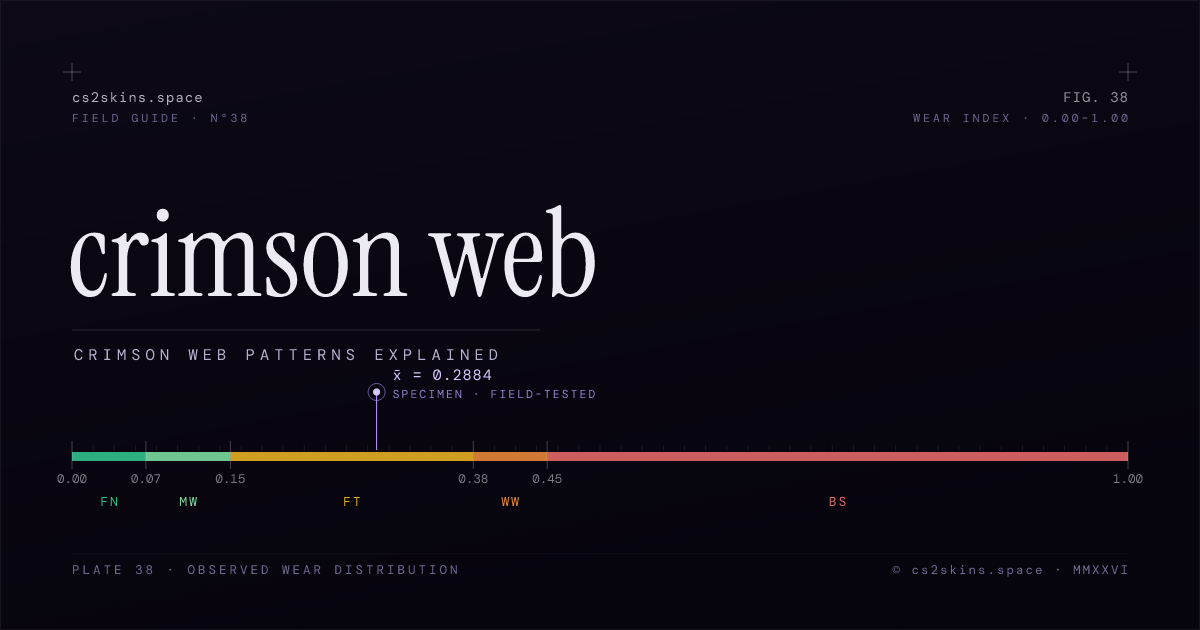
Pattern leads, but float is the supporting act. A low float keeps the red base deep and saturated and stops scratches from muddying the contrast between the crimson and the black webs. On a Factory New or Minimal Wear copy the colour pops; on a heavily worn one the red dulls and the webs lose their bite. So the ideal Crimson Web is a low float and a strong playside web — and copies that hit both at once are the ones that set records. For more on how wear is scored, see our guide to checking skin float, and browse the wear tiers overview for the exact float bands.
How to verify a Crimson Web before you buy
Never buy on the thumbnail alone. Open the listing's in-game inspect link, rotate the model, and study the playside specifically — count the webs and judge how much of the visible surface they cover. Third-party inspectors expose the exact pattern index, which you can compare against known full-web seeds for that particular knife before committing. Treat any listing that hides the inspect link or the pattern index with caution, because on Crimson Web the seed is half the value.
On our skins catalog every page lists the wear range and float caps for the finish alongside a live multi-market price grid across dozens of marketplaces, valued by our own in-house algorithm, so you can check whether a listing's pattern and float justify the ask. To understand why the very best seeds command such large premiums, the most expensive CS2 skins guide puts top-grade patterns in context.
Crimson Web, in one sentence
Crimson Web is a pattern-graded red finish where a random index decides how many webs land on the playside — buy the dense, centered, low-float copies if you're collecting, settle for a sparse pattern if you just want the look, and always confirm the seed on the inspect link first. For the full vocabulary, see our CS2 skins glossary or browse more in our guides library.