What a Marble Fade actually is
Marble Fade is a knife finish built from a fixed colour palette. On the classic version that means deep red, bright yellow and vivid blue swirled across the blade like polished stone. Some knives instead carry a Tricolor Marble Fade, which uses a different but equally fixed set of tones. Either way, the colours themselves never change between copies — every Marble Fade of a given knife draws from the same paint.
What does change is the arrangement. Because the palette is locked, the entire collector market for this finish is built around where the colours land, not which colours appear. That single fact is the key to understanding why two identical-looking listings can differ wildly in price.
Pattern index: the number that decides everything
When a Marble Fade is generated, the game assigns it a pattern index — also called the paint seed. It's a whole number that acts like a seed for how the fixed palette is painted onto the model. The seed sets the position of each colour band, the size of each section, and which colours end up on which face of the blade.
This is the same concept behind other pattern-driven finishes: just as Case Hardened "blue gems" are graded by how much blue a seed produces, Marble Fades are graded by how cleanly a seed places the red and blue. The colours are guaranteed; the placement is the lottery.
The playside is what matters
In-game you mostly see one face of the knife — the playside. So the value of a Marble Fade pattern hinges on what shows on that visible side during inspect and in your hands. A seed that buries the best colours on the backside is worth far less than one that puts them front and centre, even if both technically contain the same red, yellow and blue.
When you evaluate a listing, mentally separate "which colours exist" (the same on every copy) from "which colours I'll actually see" (different on every copy). The second question is the one that moves the price.
Fire and Ice — the chase pattern
Fire and Ice is the community name for the most coveted Marble Fade arrangement: the red ("fire") and the blue ("ice") sit next to each other and contrast like flame against frost. The ideal version has both colour tips on the playside, well separated, balanced, and free of the yellow muddying the contrast. A clean Fire and Ice is the headline pattern that pattern guides build their tier lists around.
Crucially, Fire and Ice is not a single yes/no label — it is itself tiered. A "true" Fire and Ice nails the playside placement and tip arrangement. A "fake" or low-tier Fire and Ice has the red and blue present but compromised: tucked on the backside, split awkwardly, or with a weak or missing tip. The difference between a true and a fake example can be the difference between a record price and a modest one.
Tricolor and other arrangements
Below Fire and Ice sit the everyday patterns. Tricolor layouts — where red, yellow and blue all share the playside fairly evenly — are attractive and balanced, but because they lack the sharp fire-vs-ice contrast they sell for much less than a graded Fire and Ice. Plenty of Marble Fades are simply "regular": pleasant swirls with no special placement. These are the most common and the most affordable, and they're a perfectly good buy if you want the finish without paying the pattern premium.
The takeaway: there's a clear ladder. True Fire and Ice at the top, low tier Fire and Ice next, then Tricolor and standard patterns, with price dropping at each step.
Why top patterns multiply the price
Because the palette is fixed, a great pattern is the only form of rarity a Marble Fade can offer — and rarity on a knife people inspect constantly commands a steep premium. A top-tier Fire and Ice can sell for a large multiple of a plain copy of the exact same knife and wear. The market treats the seed almost like a separate attribute layered on top of the knife itself.
This is why you should never judge a Marble Fade by its thumbnail alone. Two listings for the same knife finish at the same exterior can be ordinary and extraordinary depending entirely on one number.
Float still matters — just less
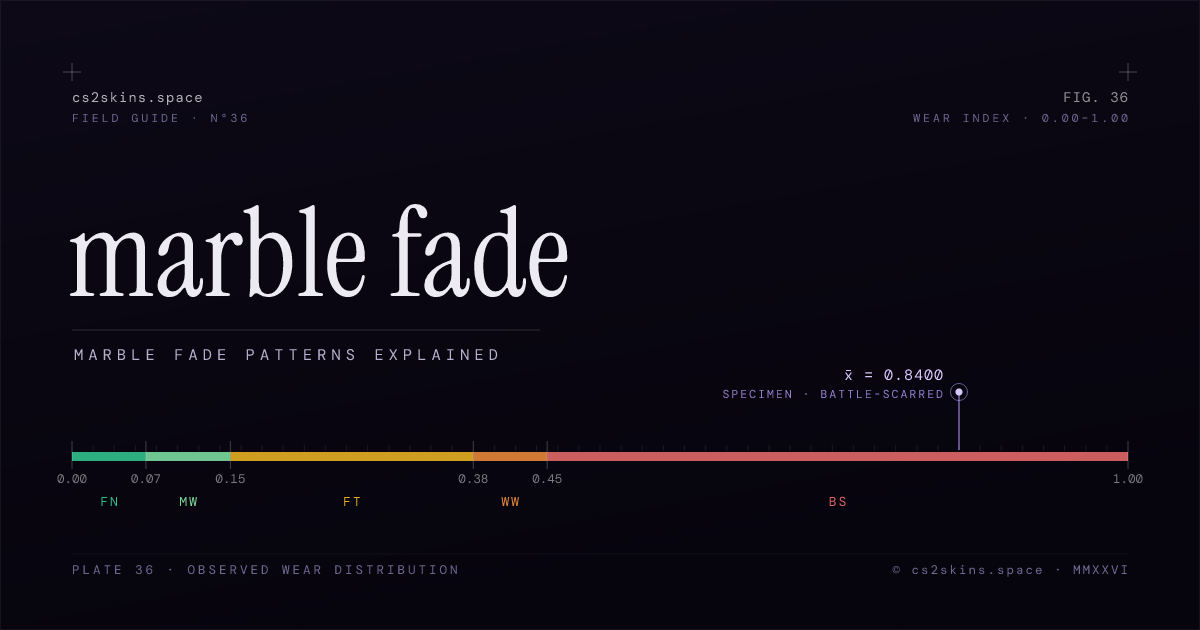
Wear isn't irrelevant. A lower float keeps the colours crisp and the boundaries between red, yellow and blue sharp, which is why collectors favour Factory New and Minimal Wear Marble Fades. The cleaner the gradient, the more obvious a great pattern reads. For the full mechanics of how wear is scored, see our guide on CS2 float value.
But on this finish, pattern outranks float. A high-grade Fire and Ice at a mid float will almost always beat a flawless-float copy with a forgettable pattern. Sort your priorities accordingly: find the pattern tier first, then chase the lowest float you can within it.
How to read and verify a Marble Fade before buying
Start with the in-game inspect link every tradeable listing exposes. Open it, rotate the blade to confirm what's on the playside, and read the pattern index in the item details. Then compare that seed against a community tier list for that specific knife — the same seed can grade differently across models, so match it to the right chart. Our guide on how to check a skin's float walks through opening inspect links and reading the spec panel step by step.
On our catalogue, every knife page lists the wear range and pattern data alongside a live multi-market price grid across dozens of marketplaces, valued by our own in-house algorithm, so you can sanity-check whether a listing's pattern tier justifies its asking price. Browse the full lineup under knives, compare value picks in our cheapest knives list, or learn the rest of the vocabulary in the CS2 skins glossary.