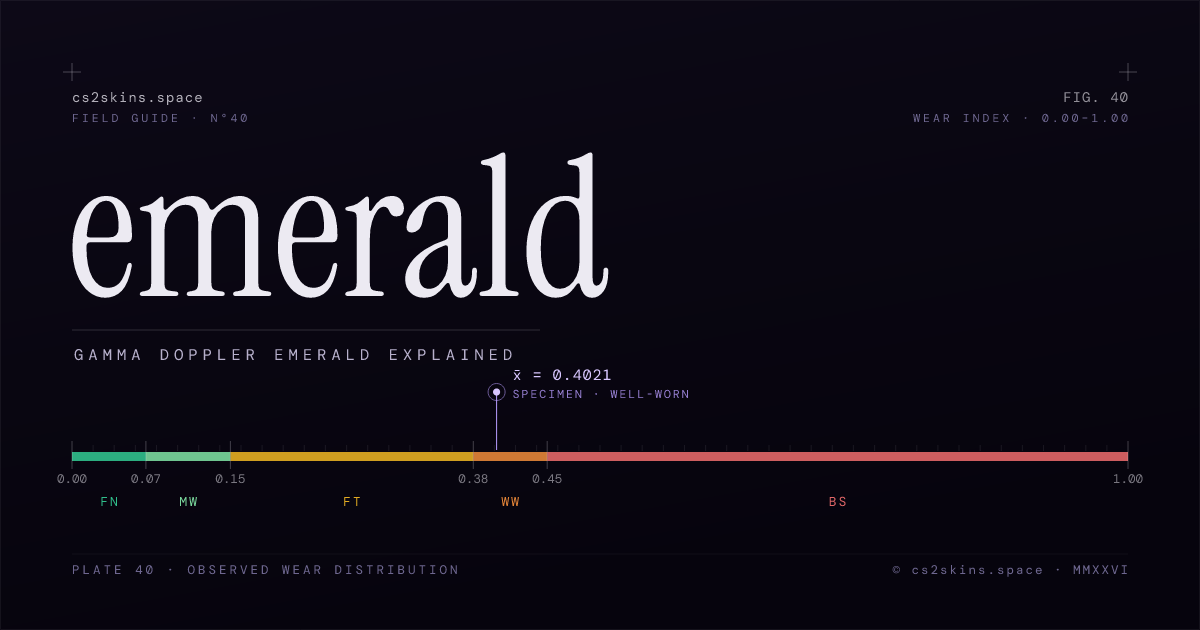
What Gamma Doppler Emerald actually is
The Doppler family is a set of gradient knife finishes built from a chromatic pattern that the game rolls into one of several phases. The original Doppler is blue-purple; the Gamma Doppler is the green-family variant, introduced with the Gamma case knives. Like its sibling, Gamma Doppler shares the four standard phases — Phase 1 through Phase 4 — each a different mix of green, black and lighter highlights.
Sitting above those four is a single rare outcome: Emerald. Where a normal phase swirls and marbles, an Emerald blade is a near-solid sheet of deep green across the playside. It is the Gamma Doppler's showpiece — the same role Ruby, Sapphire and Black Pearl play for the standard Doppler — and it only ever appears on knives.
Emerald vs. the four standard Gamma phases
Every Gamma Doppler knife rolls into one of five results. The vast majority become a numbered phase:
- Phase 1–4 — the standard outcomes. Each shows a distinct, visible pattern of green swirls mixed with black and lighter zones. They differ in how much green dominates and where the darker marbling falls.
- Emerald — the rare phase. A solid, deep green playside with little or no swirling, no Phase number, and a price tag in a different league entirely.
If you already understand how the regular blue Doppler splits into its phases and rares, the Gamma system maps onto it one-for-one — our Doppler phases explained guide walks through that structure in detail, and Emerald is simply the green-family version of the rare tier.
How to tell Emerald from a normal green phase
This is where buyers get caught out. A bright Phase 2 or Phase 4 can look convincingly green in a small thumbnail, but it is not an Emerald and is worth a fraction of the price. The tell is the playside surface:
- A standard phase always carries visible pattern — swirls, marbling, darker bands and lighter chromatic streaks woven into the green.
- A true Emerald reads as a single, even sheet of deep green with the pattern almost entirely suppressed on the playside.
Because the finish is mirrored differently on each side, sellers photograph the best face. Never judge from one image — open the in-game inspect link and rotate the model. The same habit you'd use to check a skin's float applies here: verify the item yourself before you trust the listing.
Why Emerald commands such a premium
Two forces stack on top of each other. First, rarity: with Emerald landing on roughly 1% of Gamma Doppler outcomes (the figure varies by knife), the supply of any given knife in Emerald is a tiny sliver of the supply of its standard phases. Second, demand: a clean, solid green blade is one of the most recognisable trophy finishes in the game, so collectors actively chase it.
The result is a large multiple over a Phase 1–4 of the same knife — often several times the price, and far more for the most desirable models. This guide deliberately avoids quoting exact numbers because Emerald pricing moves with the market and grades sharply on quality; for live figures we rely on our own in-house algorithm and a live multi-market price grid across dozens of marketplaces rather than any single source.
What separates a great Emerald from an average one
Not all Emeralds are equal, and the gap between a top-grade copy and a weak one is wide. Collectors grade on a handful of factors:
- Playside coverage — the prized examples have a clean, dark, fully-green playside. Lighter "creep" or black zones bleeding in from the edges drag the value down.
- Depth of green — a darker, richer green is generally favoured over a paler, washed-out tone.
- Float — a low float keeps the surface crisp and the green saturated, so sub-0.01 copies sit at the top of the ladder.
- Backside — the back is rarely as solid as the playside, but a stronger back still adds a premium.
What to check before you buy
Treat an Emerald purchase like a collector item, not a casual skin buy. Run through this list:
- Confirm it's actually Emerald, not a green standard phase, via the inspect link and the item name.
- Inspect the playside coverage in-game — rotate the model and look for creep or black zones.
- Read the exact float, since a low float meaningfully raises both looks and value.
- Sanity-check the asking price against the typical range for that knife and grade before committing.
Where Emerald sits in the green and knife landscape
Emerald is the headline act of the green knife category. If you're drawn to it for the colour, our green skins hub collects the rest of the green-family finishes worth knowing, and the knives category covers the wider knife market that Emerald sits at the very top of. To place it in context, compare it against the standard Doppler phases and the broader vocabulary in our CS2 skins glossary.
Emerald, in one sentence
Gamma Doppler Emerald is the ~1% rare green phase — a solid deep-green blade graded on playside coverage and float — worth many times a standard Gamma phase, so confirm the phase, inspect the surface and read the float before you pay. Browse more knife finishes in the skins catalog or read the rest of our CS2 guides.